Procedure
Endoscopic spine surgery in Pittsburgh
Minimally invasive options for back, neck, and nerve pain.
Endoscopic spine surgery is a minimally invasive technique that allows certain spinal conditions to be treated through very small incisions, using a camera and specialized instruments.
For the right person, this approach can reduce tissue disruption, speed recovery, and help people return to normal activity more quickly.
What this means for you
- Smaller incisions
- Less muscle disruption
- Outpatient procedures
- Faster return to normal life
Dr. Sauber explains
A short news segment from CBS Pittsburgh's KDKA, in which I explain how endoscopic spine surgery works and how it differs from traditional approaches.
CBS Pittsburgh "Eye on Health," August 2024.
What endoscopic spine surgery is
Through a very small incision — typically about seven millimeters — a thin camera and specialized instruments are introduced alongside the spine. The procedure is performed under high-definition video, with a gentle flow of fluid that keeps the working area clear. The instruments and camera pass between the muscle fibers rather than through them, leaving the muscle and bony anatomy largely undisturbed.

The endoscope and probe in use at the surgical port. Image courtesy of Arthrex.
How the procedure works
Two short patient-facing animations from Arthrex show endoscopic discectomy from start to finish — the transforaminal approach (from the side, between the muscle fibers) and the interlaminar approach (from the back, between the spinal segments). Clean 3D, with no graphic surgical footage.
Transforaminal approach
Reaches the disc from the side, through the natural foraminal opening — the approach that most cleanly minimizes muscle disruption.
Interlaminar approach
Commonly used for herniations low in the lumbar spine (L4–L5 and L5–S1).
Procedure animations courtesy of Arthrex.
The size difference, in one picture
The clearest way to understand the difference between approaches is to compare the size of the opening each one requires.
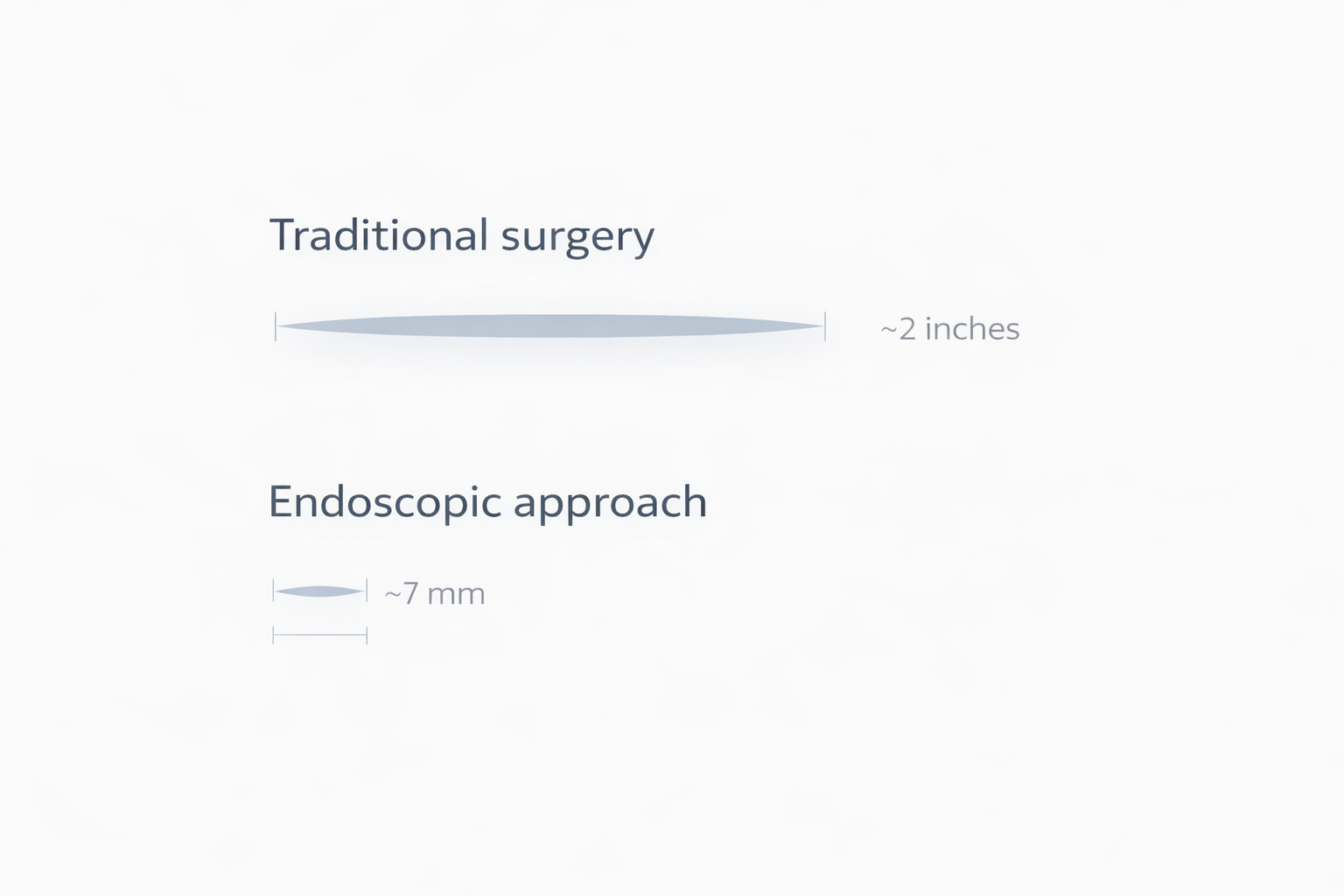
Approximate incision sizes for the three common surgical approaches.
Conditions treated endoscopically
Not all spinal conditions can or should be treated with endoscopic techniques. The most important step is an accurate diagnosis and matching the treatment to the problem. In many cases, non-surgical care is still the best option. When surgery is appropriate, the goal is the least invasive approach that genuinely fits.
-
Lumbar disc herniation
The most common cause of sciatica. Treated through a tiny opening as an endoscopic discectomy.
-
Cervical radiculopathy
Pinched nerve in the neck. Motion-preserving endoscopic foraminotomy is an alternative to fusion in select cases.
-
Lumbar spinal stenosis
Leg pain with walking. Endoscopic decompression, usually without fusion.
-
Lumbar facet cyst
When injections don't last. Endoscopic resection, typically without fusion.
-
Recurrent disc herniation
Revision from the side, through virgin tissue — avoiding scar from the prior surgery.
-
Thoracic disc herniation
A far less invasive alternative to traditional open thoracic surgery.
-
Far lateral disc herniation
Herniations outside the spinal canal — the lateral endoscopic approach naturally aligns with this anatomy.
-
Foraminal stenosis
Narrowing where a nerve exits the spine, often confused with central stenosis.
-
Adolescent pars fractures
A specific cause of low back pain in young athletes; endoscopic techniques can be used in selected cases.
Procedures performed
Endoscopic and minimally invasive techniques can be used in a variety of procedures, including:
- Lumbar discectomy Removal of disc material pressing on a spinal nerve in the lower back.
- Cervical foraminotomy and discectomy Decompression of a nerve root in the neck, often as a motion-preserving alternative to fusion.
- Thoracic discectomy Disc removal in the mid-back through a smaller, safer corridor than traditional open surgery.
- Unilateral laminotomy for bilateral decompression (ULBD) Opening both sides of the spinal canal from a single small entry on one side — treatment for central stenosis without fusion.
- Pars repair and decompression Endoscopic options exist for selected pars fractures, particularly in young athletes.
The specific procedure depends on the underlying condition and individual anatomy.
Where endoscopic surgery fits — and where it doesn't
An honest assessment of whether endoscopic surgery is the right answer for a particular situation matters more than the technique itself.
Well-suited to
- Lumbar disc herniations with a surgically accessible fragment
- Cervical radiculopathy from lateral disc material or bone spurs
- Lateral recess and selected central stenosis
- Recurrent herniation through a previously operated level
Not the right answer for
- Significant spinal instability requiring fusion
- Large or complex deformities
- Severe multi-level central stenosis with myelopathy
- Conditions where another approach is genuinely better
What to expect
These procedures are performed through small incisions using specialized instruments and a camera to directly visualize the affected area. Procedures are typically performed on an outpatient basis, so most people return home the same day. Recovery varies depending on the condition treated, but many people are able to resume activity within a couple of days.
In selected cases, these procedures may be performed using light sedation rather than general anesthesia. This isn't appropriate for every situation, but when possible it can allow for a more comfortable recovery and may reduce some of the risks associated with general anesthesia.
Want a closer look at the procedure?
A visual walk-through with the step-by-step sequence, the muscle-sparing comparison, and answers to the questions patients ask most.
What endoscopic spine surgery looks like →The goal of endoscopic spine surgery isn't to perform more procedures — it's to provide a targeted, less invasive option when that's the right answer, and to be clear when it isn't. If you're experiencing back, neck, or nerve-related pain and want to understand whether a minimally invasive approach makes sense for your situation, I'd be glad to discuss the options at an appointment.