Patient education
Minimally invasive spinal fusion in Pittsburgh
Robotic-guided fusion for spondylolisthesis with stenosis, and what recovery looks like.
Reviewed by Ryan Sauber, MD · Fellowship Director, AHN Orthopaedic Spine Fellowship · Last reviewed October 2026
A spinal fusion joins two vertebrae so the segment between them stops moving. In the lower back, the most common reason to do one is spondylolisthesis, where one vertebra has slipped forward on the one below, when that slip moves and narrows the space for the nerves. Done through small incisions with robotic guidance, the operation is much smaller than a traditional open fusion, and many patients go home the same day.
Most people with a slipped vertebra never need surgery. For those who do, whether the right operation is a decompression or a fusion depends on the details of the exam and imaging. If you're still working out where you stand, start with spondylolisthesis, which covers symptoms, non-surgical care, and the fusion question in more detail. This page picks up when fusion is the right answer.
When fusion is the right answer
Fusion makes sense when the spine at one level is moving more than it should and that motion is part of the problem. The typical picture is a slip that shifts on bending X-rays together with stenosis, the narrowing that causes leg pain and heaviness with walking. Removing bone to free the nerves at an unstable level can make the slip worse, so the segment is stabilized at the same operation.
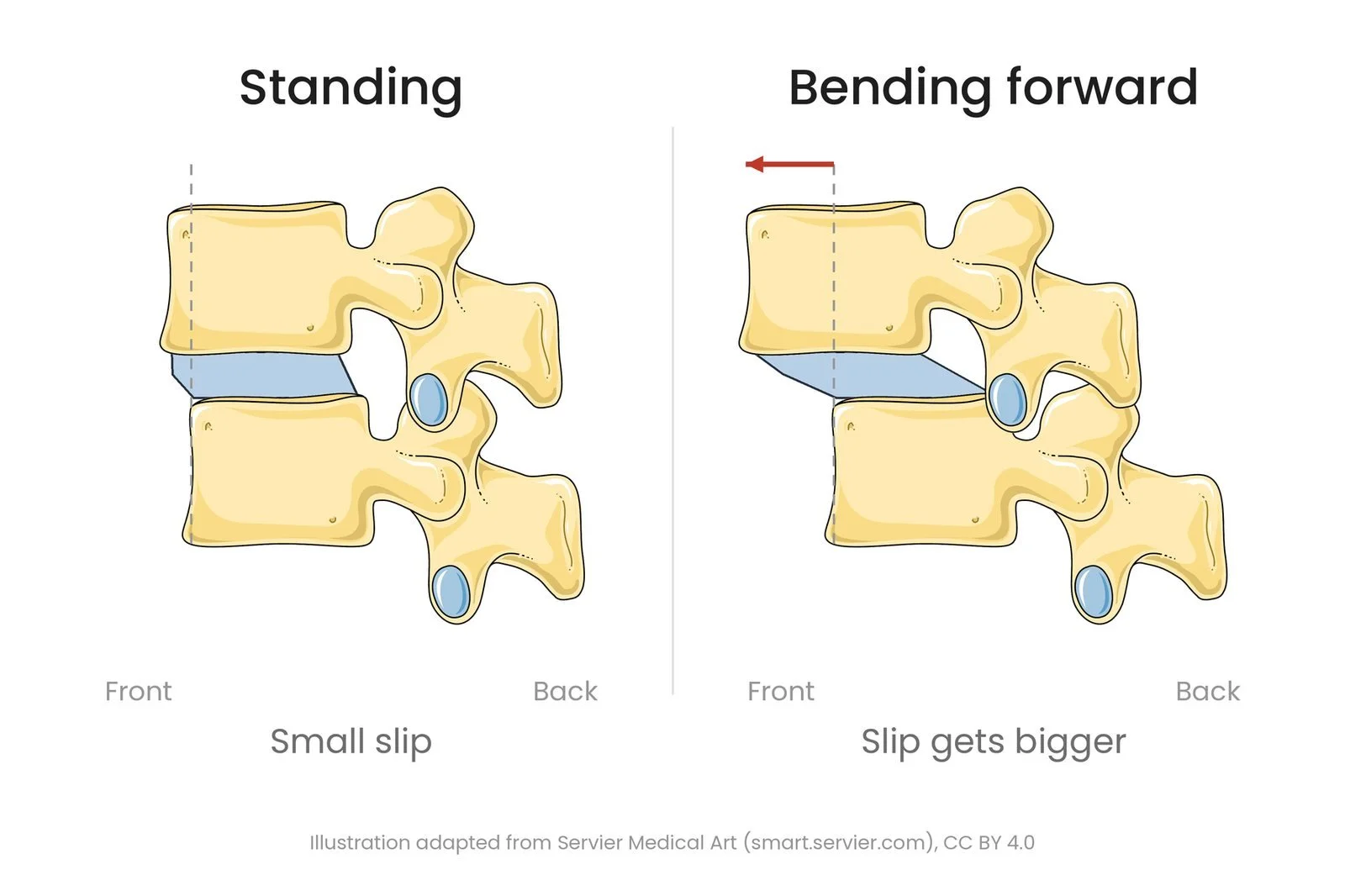
Some patients with a stable slip and pinched nerves can be treated with a decompression alone; spinal stenosis covers that path. When the slip is moving, a decompression by itself can leave the instability behind, and a fusion is the operation that treats the whole problem. Fusion is also not a reliable fix for back pain in a spine that is otherwise stable; fusion versus disc replacement explains why.
What minimally invasive fusion involves
The operation is a transforaminal lumbar interbody fusion, or TLIF. Through small incisions in the back, the surgeon frees the pinched nerves, clears out the worn disc between the two vertebrae, and places a spacer filled with bone graft in that space. Screws and rods hold the two vertebrae still while the bone grows across and the fusion heals over the following months.
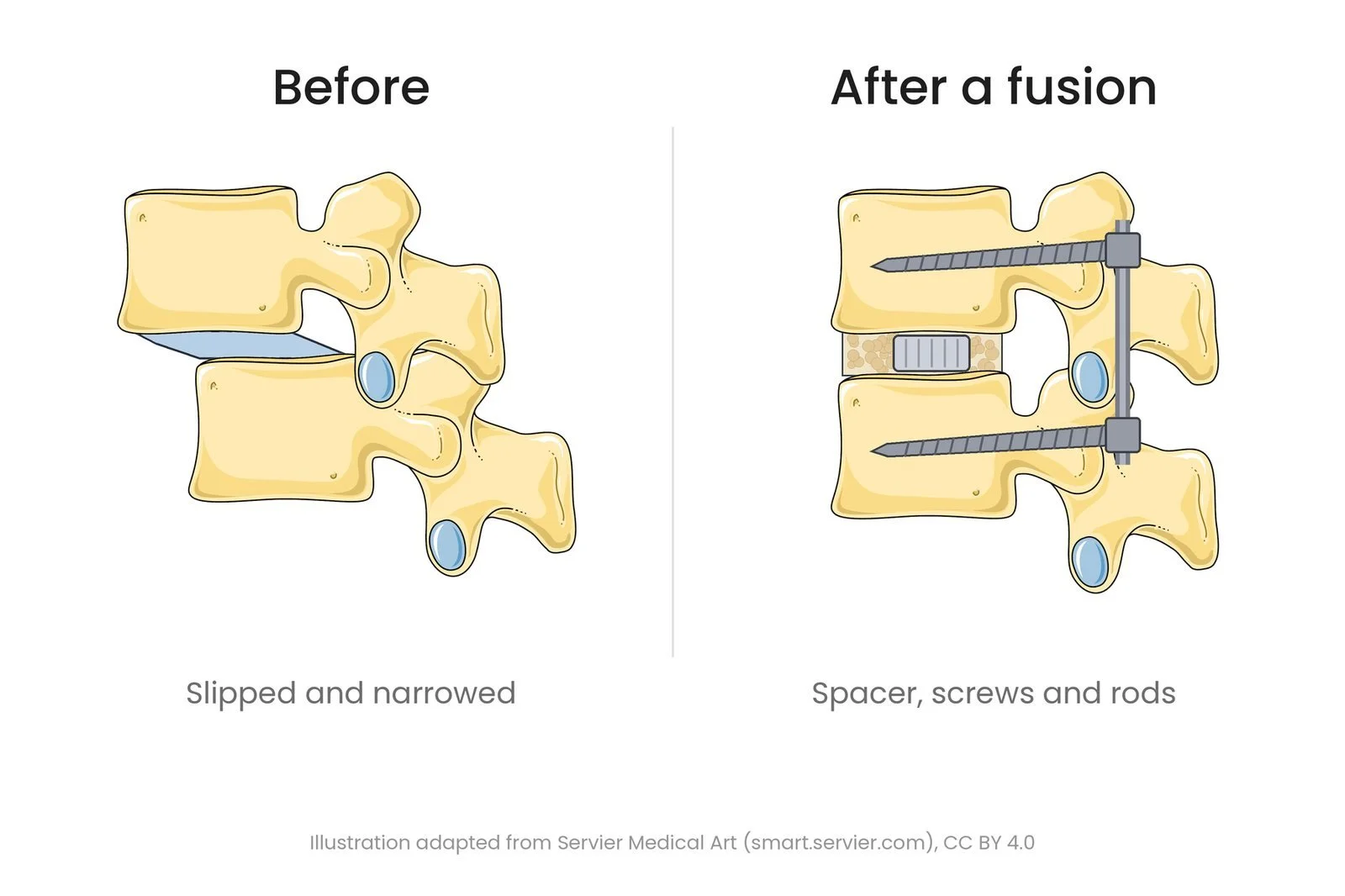
Compared with a traditional open fusion, the muscles of the back are spread apart rather than stripped from the spine. That usually means less pain in the first weeks and a faster return to walking.
How the robot is used
Dr. Sauber uses the Stealth AXiS surgical system from Medtronic, which combines surgical planning, navigation and a robotic arm, for screw placement and bone cuts. Imaging is taken in the operating room, and the surgeon plans the path of each screw on that image. The robotic arm then holds a guide in exactly that position, and the surgeon places the screw through the guide. The system is also used to make precise bone cuts that the surgeon has planned, which makes the operation more efficient.
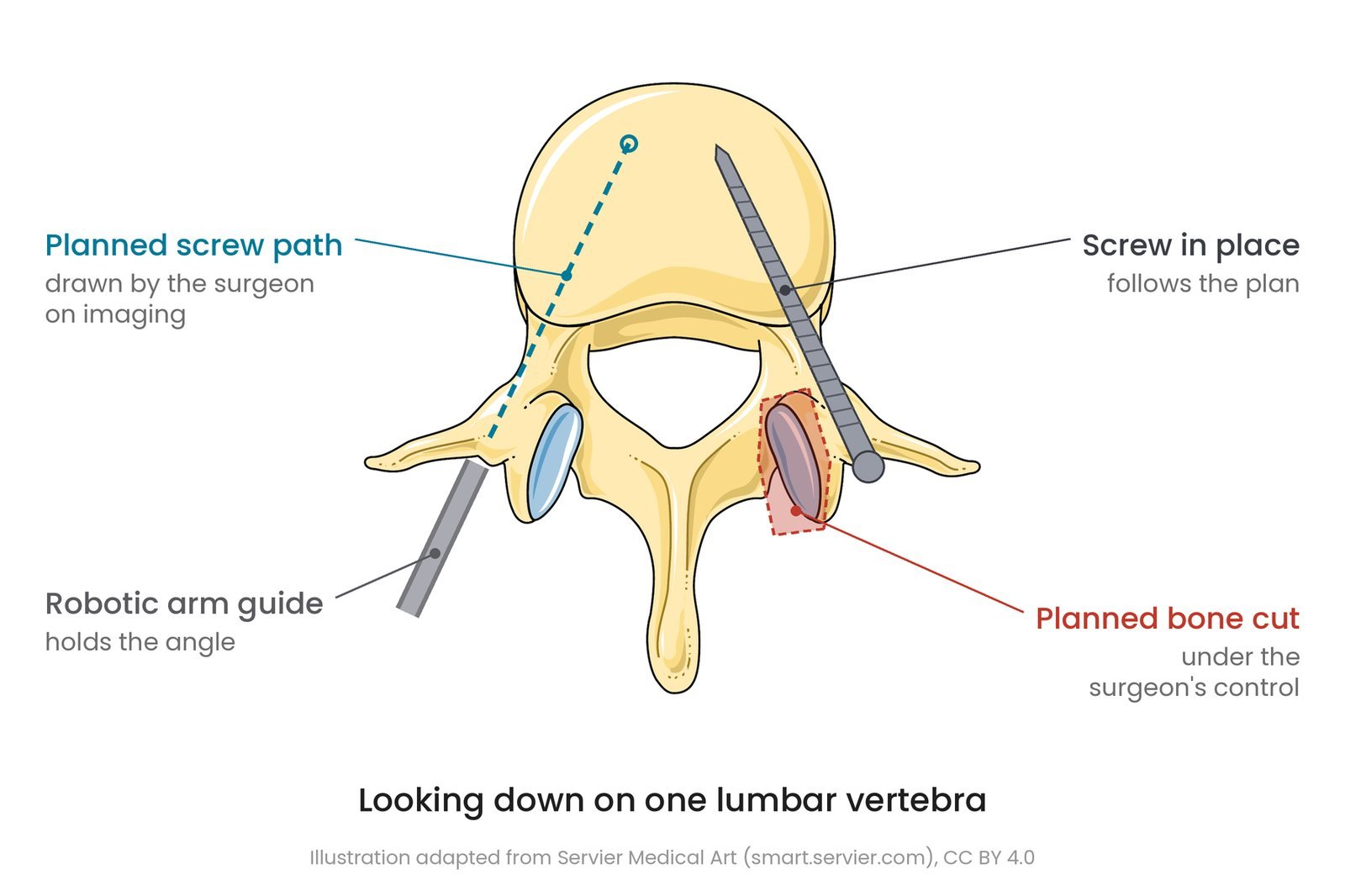
The robot doesn't operate on its own and doesn't make decisions. Its job is precision: placing screws and cutting bone accurately through small incisions without needing a large opening to see the anatomy directly.
Going home the same day
Many patients go home the same day, on a recovery pathway built around early walking and good pain control. Whether that fits you is decided before surgery. Same-day spine surgery covers how that works across different operations.
| Same day is more likely with | An overnight stay is more likely with |
|---|---|
| A fusion at one level | A fusion of more than one level |
| Good overall health | Other medical conditions that need watching |
| Younger age | Older age |
| Someone at home to help | No one at home to help |
Recovery
- Day of surgery
- Most patients are up and walking within an hour or two of surgery.
- First weeks
- Walking is the main therapy, a little more each day. Physical therapy is a useful tool for selected patients rather than a requirement for everyone.
- Two to three weeks
- Most people are driving again.
- Three to four weeks
- Desk work usually resumes.
- First three months
- No lifting more than 15 pounds and no yardwork while the fusion heals. Heavier activity and physical work come back after that, guided by how the fusion is healing.
Common questions
Do I need a fusion for spondylolisthesis?
Not always. Many people with a slip do well without surgery. When surgery is needed, the choice depends on whether the slip is moving. If it moves on bending X-rays and is narrowing the space for the nerves, fusion is usually the right operation, because it treats the instability as well as the pinched nerves.
Is robotic spine surgery done by a robot?
No. The surgeon plans and performs the operation. The robot holds a guide at the angle the surgeon planned for each screw, using imaging taken during surgery, and helps make precise, planned bone cuts. Everything happens under the surgeon's control.
Will I go home the same day?
Many healthy patients having a single-level fusion do. An overnight stay is more likely with older age, other medical conditions, a fusion of more than one level, or no one to help at home.
When can I drive?
Usually by two to three weeks after surgery.
When can I go back to work?
Desk work usually by three to four weeks. Physical jobs take longer and depend on the work, because lifting is limited while the fusion heals.
Will I need physical therapy?
Walking is the best therapy for most people, starting the day of surgery. Physical therapy is a useful tool for selected patients rather than something everyone needs.
Talking it through
Minimally invasive and robotic-guided fusion is part of Dr. Sauber's practice alongside endoscopic surgery, and with every patient who has a slip, he explains why a fusion or a decompression is the better fit for their spine. If you've been told you may need a fusion and want to understand whether it fits your imaging, he's glad to go over it with you at an appointment.
Further reading
- American Academy of Orthopaedic SurgeonsAdult Spondylolisthesis in the Low Back
- Mayo ClinicSpondylolisthesis
- Cleveland ClinicSpondylolisthesis
- NIH MedlinePlusSpondylolisthesis
- North American Spine SocietyClinical Practice Guidelines